


 English
 中文简体
中文简体 Español
 русский
 عربى
عربى
Content
- 1 Direct Answer: Can Nylon 6 Be Dyed Easily?
- 2 Why the Chemical Structure of Nylon 6 Favors Dyeing
- 3 Compatible Dye Types for Nylon 6 Polymers
- 4 Technical Comparison: Dyeing Characteristics
- 5 Factors That Influence Dyeing Success
- 6 Common Applications of Dyed Nylon 6
- 7 Tips for DIY or Small-Batch Dyeing
- 8 Final Conclusion
Direct Answer: Can Nylon 6 Be Dyed Easily?
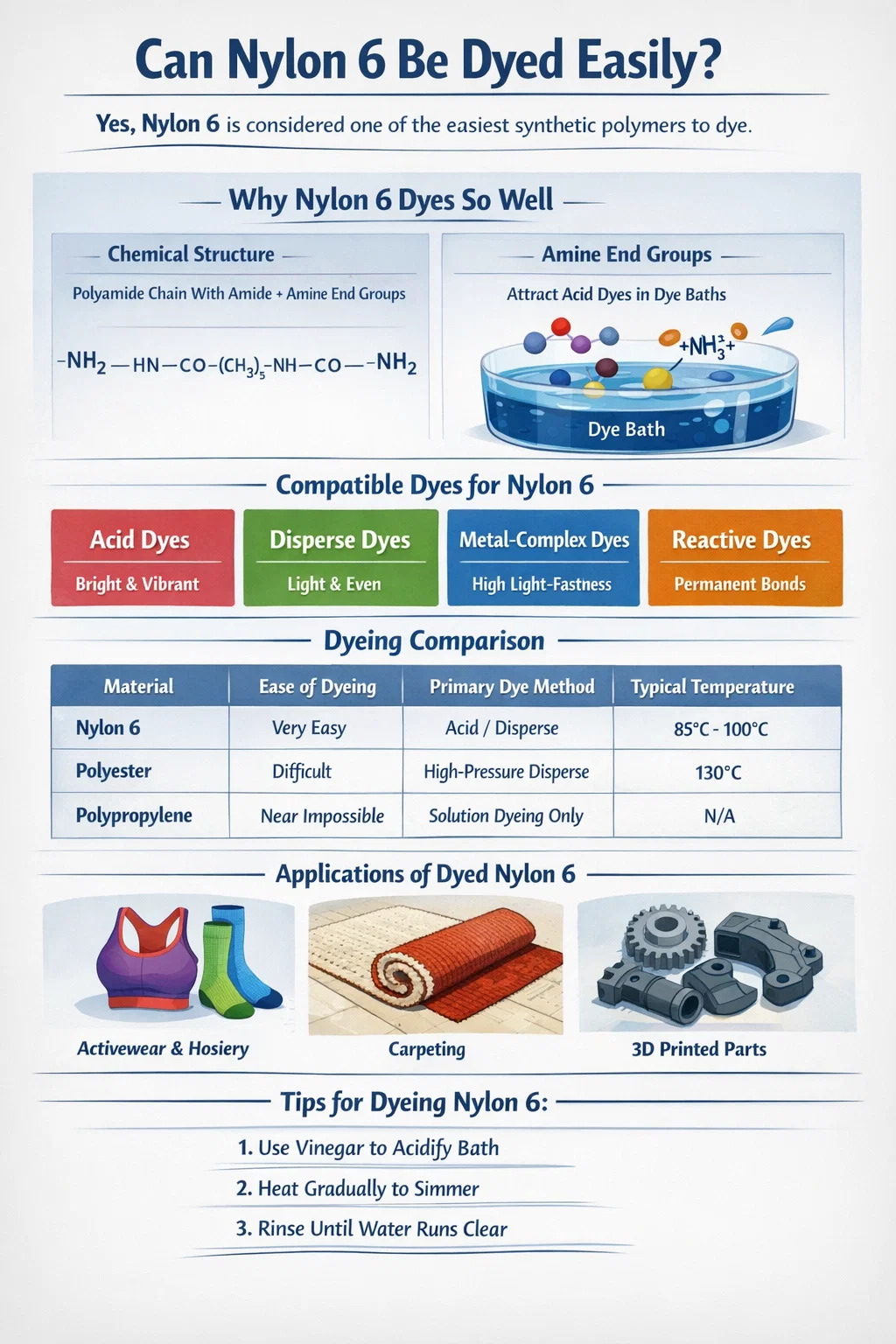
Yes, Nylon 6 is considered one of the easiest synthetic polymers to dye, especially when compared to other plastics like polyester or polypropylene. Its unique chemical structure contains numerous reactive sites that allow dye molecules to form strong, permanent bonds. This high affinity for colorants means that Nylon 6 can achieve vibrant, deep hues and excellent color fastness using standard aqueous dyeing processes at relatively low temperatures.
Why the Chemical Structure of Nylon 6 Favors Dyeing
The secret to the superior dyeability of Nylon 6 lies in its molecular makeup. As a polyamide, it features a repeating chain of amide groups (-CO-NH-) and, crucially, terminal amino groups (-NH2) at the ends of its polymer chains.
Amine End Groups and Dye Sites
The amino end groups act as "anchors" for acid dyes. These groups become positively charged in an acidic dye bath, creating a powerful electrostatic attraction for negatively charged dye anions. Because Nylon 6 typically has a higher concentration of these amine ends compared to Nylon 6,6, it often displays a faster rate of dye uptake.
Open Polymer Structure
Compared to more rigid polymers, Nylon 6 has a slightly more "open" or less crystalline structure in certain states. This allows water and dye molecules to penetrate the fiber core more effectively when heated. This accessibility ensures that the color is not just sitting on the surface but is integrated throughout the material.
Compatible Dye Types for Nylon 6 Polymers
The versatility of Nylon 6 is reflected in the wide range of dyes that can be used to color it. Each dye type offers different benefits regarding brightness and durability.
- Acid Dyes: The most common choice for Nylon 6. These provide exceptional brightness and a vast palette of colors.
- Disperse Dyes: Often used for lighter shades or when aiming for high levelness (uniformity). They work by migrating into the polymer matrix.
- Metal-Complex Dyes: Preferred for industrial applications requiring extreme light-fastness and resistance to washing.
- Reactive Dyes: These form a covalent bond with the nylon, making the color almost impossible to remove.
Technical Comparison: Dyeing Characteristics
To understand why Nylon 6 is selected for color-critical applications, it is helpful to compare it with other common materials.
| Material | Ease of Dyeing | Primary Dye Method | Typical Temperature |
|---|---|---|---|
| Nylon 6 | Very Easy | Acid / Disperse | 85°C - 100°C |
| Nylon 6,6 | Easy | Acid / Metal-Complex | 95°C - 100°C |
| Polyester | Difficult | High-Pressure Disperse | 130°C |
| Polypropylene | Near Impossible | Solution Dyeing Only | N/A |
Factors That Influence Dyeing Success
While Nylon 6 is naturally receptive to color, several factors must be managed to ensure a high-quality finish.
pH Control
For acid dyes to work, the dye bath must be slightly acidic (usually a pH between 4.0 and 6.0). If the pH is too high, the dye won't bond; if it's too low, the dye might rush onto the material too quickly, causing splotches or uneven color.
Temperature Management
Nylon 6 begins to absorb dye significantly once the temperature exceeds its glass transition point (around 40°C to 50°C in water). For maximum saturation, the bath is usually brought to a slow boil. A gradual temperature increase (e.g., 1-2 degrees per minute) is vital for achieving a perfectly level, professional look.
Moisture Absorption
Nylon 6 is hygroscopic, meaning it absorbs water. This is a massive advantage in dyeing because the water acts as a carrier, pulling the dye deep into the polymer. Nylon 6 can absorb up to 8% to 10% of its weight in moisture at saturation, which facilitates incredibly deep color penetration compared to hydrophobic plastics.
Common Applications of Dyed Nylon 6
Because of its ease of coloring, Nylon 6 is the go-to material for industries where aesthetics and color variety are paramount.
- Apparel and Hosiery: Most swimwear, activewear, and stockings use Nylon 6 because it can be dyed in neon or ultra-vibrant colors that stay bright even after repeated washing.
- Carpeting: The carpet industry relies heavily on Nylon 6 fibers because they can be "post-dyed," allowing manufacturers to keep white carpet in stock and dye it to a specific trendy color as orders come in.
- 3D Printing and Prototyping: Nylon 6 filaments used in 3D printing can be dyed using simple fabric dyes after the print is finished, allowing for custom-colored mechanical parts.
Tips for DIY or Small-Batch Dyeing
If you are working with Nylon 6 parts or fabrics on a smaller scale, follow these constructive steps for the best results:
- Pre-wash the material: Remove any oils, lubricants, or finishes that might block dye absorption.
- Use a vinegar "activator": Adding a few tablespoons of white vinegar to the dye bath lowers the pH and triggers the chemical bonding process.
- Maintain heat: Keep the water just under a simmer for at least 30 to 60 minutes.
- Rinse thoroughly: Start with warm water and gradually move to cold water until the water runs clear to prevent future bleeding.
Final Conclusion
In the world of synthetic polymers, Nylon 6 stands out as a champion of colorability. Its chemical affinity for acid dyes, combined with its moisture-absorbing nature, makes it an incredibly forgiving and rewarding material to work with. Whether for industrial textiles or custom-engineered components, the ability to easily dye Nylon 6 ensures it remains a top choice for designers who refuse to compromise on color intensity or durability.
 Mob: +86-15867822829
 Tel: +86-0574-62538663
 Fax: +86-0574-62530664
 E-mail:
 Follow Us
 Home
Home
