


 English
 中文简体
中文简体 Español
 русский
 عربى
عربى
Content
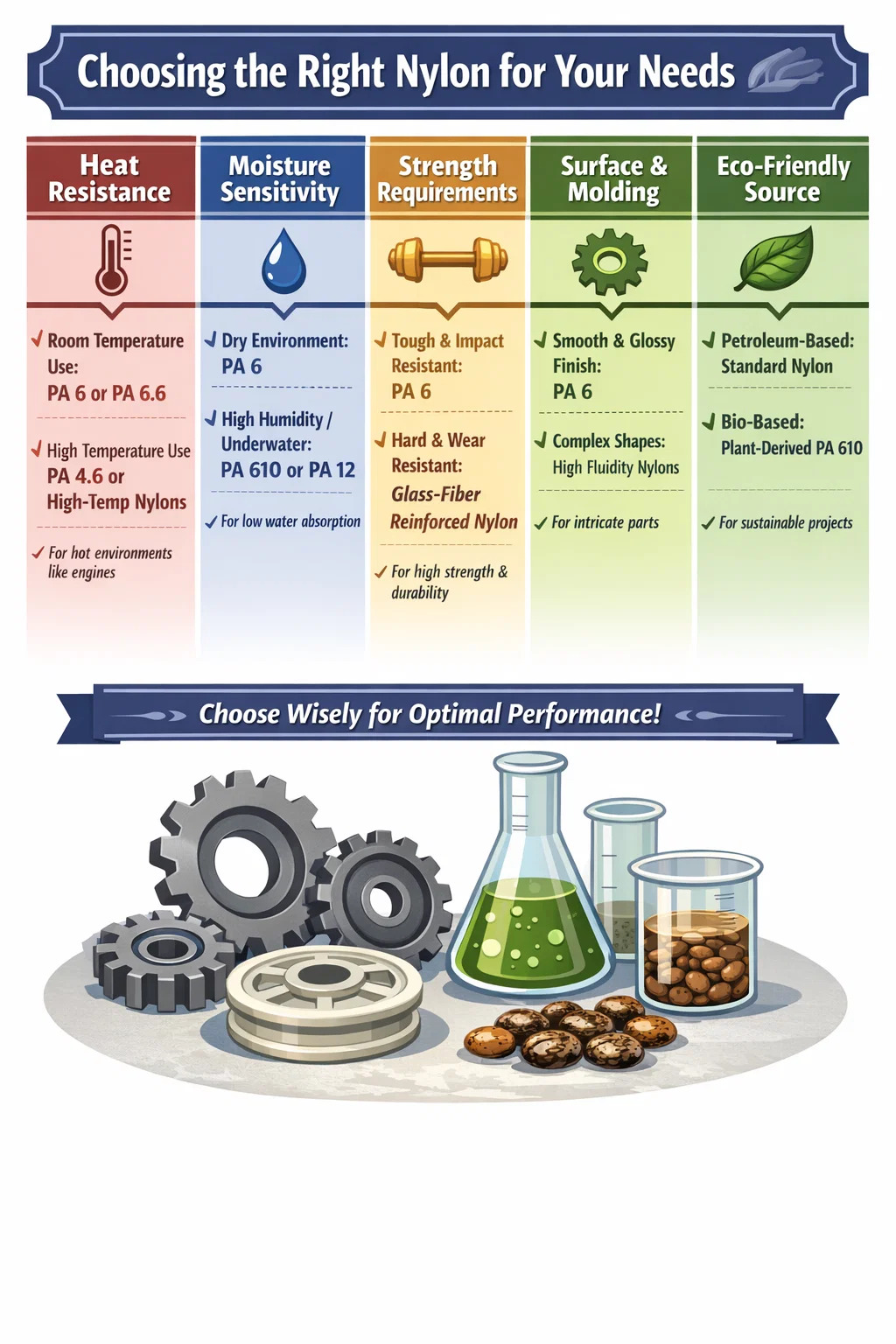
Faced with the wide variety of nylon materials on the market, choosing the right "type" is as important as choosing the right size and material when buying clothes. The polyamide family has many members, each with its own characteristics. To choose the most suitable one, you can consider the following practical aspects:
► First, consider whether your part is sensitive to heat.
Environmental temperature is the first criterion for selecting materials.
General household or ordinary industrial use: If the part only works at room temperature or in a mild environment, the classic Polyamide 6 or PA 6.6 will suffice. They are cost-effective and can handle most everyday situations.
High-temperature applications: If your part will be near a car engine or a high-power motor, you need to consider PA 4.6 or some specialized high-temperature resistant nylons. Ordinary nylon will soften like a candle and even lose its support in these environments.
► Consider whether the environment is very humid.
Nylon has an inherent weakness—it absorbs water (hygroscopicity).
Dry environment: PA 6 is very useful and has good toughness.
Underwater or in humid southern climates: If your parts require very precise dimensions (such as fine gears), they will expand slightly after absorbing water, which may cause jamming. In this case, you can choose models with lower water absorption rates, such as PA 610 or PA 12, which do not change much in size even when immersed in water.
► How much "strength" does the part need?
Do you want the part to be as soft as noodles or as hard as a stone?
For toughness and impact resistance: For example, for luggage handles or sports protective gear, Polyamide 6 has excellent impact resistance and is not prone to cracking.
For hardness and wear resistance: If you need to make load-bearing brackets or wear-resistant pulleys, you can look for "reinforced" versions of the raw materials, such as those reinforced with glass fiber. This type of nylon feels very hard and is very tensile. ⇨ Appearance and Surface Finish
Pursuing a beautiful surface: If your product is exposed to the outside, such as an appliance casing, PA 6 generally has a better surface gloss and a finer appearance than PA 6.6, and is less prone to rough textures.
Complex shapes: Some nylons have good fluidity, easily filling complex mold cavities like water, making them suitable for oddly shaped small parts.
► Considering the "Origin" and Source (Polyamide Source)
Many companies now prioritize environmental protection, and the source of nylon has become a selection criterion.
Traditional source: Most nylon is derived from petroleum.
Green source: There are also many nylons extracted from plants (such as castor oil), which are known as bio-based nylons (such as some components of PA 610). If your project emphasizes green and environmental protection, this type of polyamide source will be more attractive.
 Mob: +86-15867822829
 Tel: +86-0574-62538663
 Fax: +86-0574-62530664
 E-mail:
 Follow Us
 Home
Home
