


 English
 中文简体
中文简体 Español
 русский
 عربى
عربى
Content
- 1 The Direct Answer: Nylon 6 Is Not Compostable
- 2 What Compostability Actually Means and Why Nylon 6 Fails the Test
- 3 How Long Does Nylon 6 Take to Degrade in the Environment?
- 4 Biodegradability vs. Compostability: A Distinction That Matters for Nylon 6
- 5 Nylon 6 vs. Other Materials: Environmental Persistence Compared
- 6 The Microplastic Problem: What Happens When Nylon 6 Breaks Down
- 7 Bio-Based Nylon 6: Does It Change the Compostability Equation?
- 8 Emerging Research: Can Nylon 6 Be Made Compostable?
- 9 Recycling as the Realistic End-of-Life Path for Nylon 6
- 10 Practical Implications for Consumers and Product Designers
- 11 The Regulatory Landscape: Green Claims and Nylon 6
- 12 Summary: What You Need to Know About Nylon 6 and Compostability
The Direct Answer: Nylon 6 Is Not Compostable
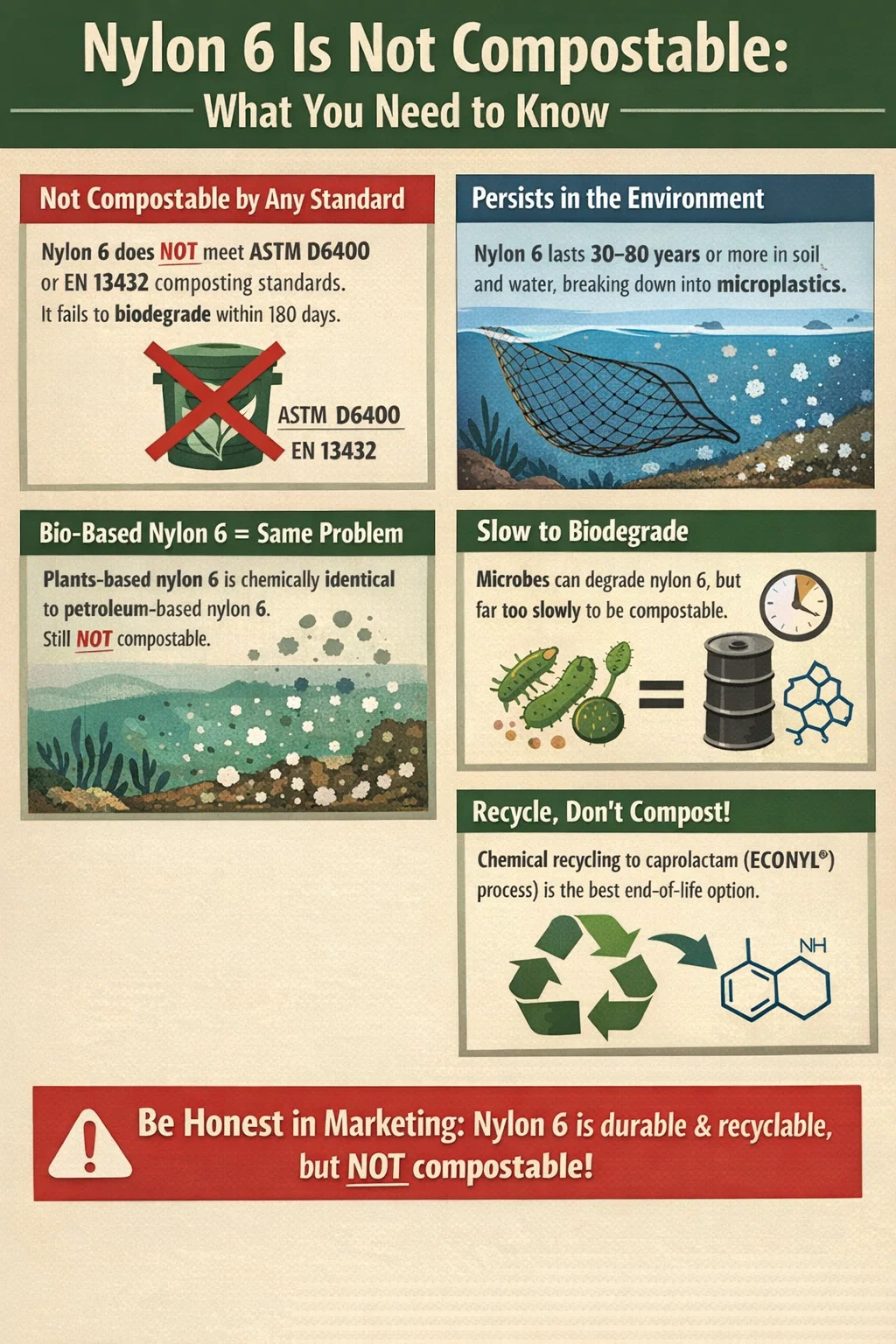
Nylon 6 is not compostable under any standard composting conditions — neither home composting nor industrial composting. It is a synthetic polymer derived from petrochemical feedstocks, and its molecular structure does not break down through the biological processes that decompose organic matter. In a typical compost environment, nylon 6 will remain structurally intact for decades, possibly centuries, without meaningful degradation.
This is a point worth stating clearly because the word "nylon" sometimes appears alongside biodegradable or sustainable marketing language in textiles and consumer products, creating confusion among buyers who want to make environmentally responsible choices. Standard nylon 6, as produced from caprolactam — a petroleum-derived monomer — is a persistent plastic material in the same category as polyethylene or polypropylene when it comes to environmental persistence.
That said, the situation is not entirely static. Ongoing research into bio-based nylon 6, enzymatic degradation, and specialized additive technologies is creating a more nuanced picture that is worth understanding in full if you are evaluating nylon 6 for sustainability-related decisions.
What Compostability Actually Means and Why Nylon 6 Fails the Test
Compostability is a defined technical standard, not a general impression of environmental friendliness. The most widely referenced standards are ASTM D6400 (used in North America) and EN 13432 (used in Europe). Both require that a material:
- Disintegrate into fragments no larger than 2mm within 12 weeks under industrial composting conditions (typically 58°C, controlled humidity and aeration)
- Biodegrade at least 90% of its organic carbon into CO₂ within 180 days
- Leave no toxic residues — the resulting compost must support plant growth equivalent to an untreated control
- Not contain heavy metals above regulated thresholds
Nylon 6 fails the biodegradation requirement decisively. Studies on the environmental persistence of polyamides show that nylon 6 does not reach 90% carbon mineralization within the 180-day test window — or anywhere near it. The amide bonds in nylon 6 are relatively resistant to the hydrolytic and enzymatic attack that drives biological decomposition. While nylon 6 can hydrolyze slowly in acidic or alkaline conditions, the neutral-to-mildly-alkaline pH of a compost heap does not provide the chemical conditions needed for significant chain scission within the relevant timeframes.
For comparison, materials like polylactic acid (PLA) are designed to achieve the ASTM D6400 thresholds in industrial composting. PLA degrades through hydrolysis of its ester bonds, a process accelerated by the elevated temperature and moisture of an industrial compost facility. Nylon 6's amide bonds are chemically more stable than PLA's ester bonds, which is part of what makes nylon 6 a durable engineering material — but also what makes it environmentally persistent.
How Long Does Nylon 6 Take to Degrade in the Environment?
Precise degradation timelines for nylon 6 in natural environments are difficult to establish because degradation rates depend heavily on environmental conditions — UV exposure, temperature, humidity, microbial activity, and mechanical stress all play roles. However, the available evidence points to nylon 6 persisting in soil or marine environments for 30–80 years or more under typical ambient conditions before showing substantial physical breakdown.
UV radiation from sunlight is actually the most effective natural degradation driver for nylon 6. Photooxidation causes chain scission at the polymer surface, leading to yellowing, embrittlement, and eventual fragmentation into smaller pieces. However, this is physical fragmentation, not biodegradation — the resulting particles are microplastics, not harmless organic compounds. In soil or underwater where UV exposure is limited, nylon 6 degrades even more slowly.
Nylon 6 fishing nets and aquaculture equipment lost or discarded in marine environments present a well-documented problem. These so-called "ghost nets" can persist for decades while continuing to entangle and harm marine wildlife. This is a direct real-world illustration of nylon 6's environmental persistence, far removed from compostability in any meaningful sense.
In contrast, a piece of food waste placed in the same environment would be fully decomposed by microbial activity within weeks. A cotton garment buried in moist soil would be largely unrecognizable within one to five years. Nylon 6 under the same conditions would remain substantially intact.
Biodegradability vs. Compostability: A Distinction That Matters for Nylon 6
These two terms are often used interchangeably, but they describe different things, and the distinction is especially relevant for nylon 6.
Biodegradable means that microorganisms can break down a substance into water, CO₂, and biomass over some timeframe — but the timeframe is unspecified. Virtually any organic molecule is technically biodegradable given enough time and the right conditions. Some plastics labeled as "biodegradable" may take hundreds of years to mineralize under realistic environmental conditions, making the label practically misleading.
Compostable is more demanding — it requires biodegradation to occur within a defined short timeframe (typically 180 days) under controlled composting conditions, without leaving harmful residues.
Nylon 6 is technically biodegradable in the broadest sense — there are microorganisms, including certain strains of fungi and bacteria, that can attack and partially metabolize nylon 6 under specific laboratory conditions. Research has identified organisms such as Flavobacterium species, certain white rot fungi, and bacteria with nylonase enzymes capable of cleaving amide bonds. However, the rate of biological degradation in these studies is far too slow to meet compostability standards, and the conditions under which significant degradation is observed are not representative of a backyard compost bin or an industrial composting facility.
So the accurate statement is: nylon 6 shows very limited and slow biodegradability under specific conditions, but it is definitively not compostable by any current recognized standard.
Nylon 6 vs. Other Materials: Environmental Persistence Compared
Putting nylon 6's environmental profile in context with other common materials helps illustrate where it sits on the spectrum from readily compostable to highly persistent.
| Material | Compostable? | Estimated Environmental Persistence | Notes |
|---|---|---|---|
| Food waste | Yes (home and industrial) | Weeks | Fully biodegrades in soil |
| Cotton | Yes (home and industrial) | 1–5 years in soil | Faster if untreated/undyed |
| PLA (polylactic acid) | Industrial only | Decades in ambient soil | Requires 58°C+ to degrade meaningfully |
| Nylon 6 | No | 30–80+ years | Fragments into microplastics under UV |
| Polyethylene (PE) | No | 100–500+ years | Among most persistent plastics |
| Polyester (PET) | No | 200–400+ years | Sheds microfibers in laundry |
| Wool | Yes (home and industrial) | 1–5 years in soil | Protein-based, readily biodegrades |
Nylon 6 sits in a middle zone — more degradable than HDPE or PET in very long timeframes, but far more persistent than natural fibers or purpose-designed bioplastics. It does not earn any compostability designation under current standards.
The Microplastic Problem: What Happens When Nylon 6 Breaks Down
When nylon 6 does break down — through UV exposure, mechanical abrasion, or slow hydrolysis — it does not disappear into harmless molecules. It fragments into progressively smaller pieces, eventually becoming microplastics (particles between 1 micrometer and 5 millimeters) and nanoplastics (below 1 micrometer).
Nylon 6 microfibers are a particular concern in the textile sector. Research published in environmental science journals has found that a single wash of a synthetic garment can release hundreds of thousands to over one million microfibers per wash cycle, depending on fabric construction and washing conditions. Nylon 6 sportswear, swimwear, hosiery, and activewear are all significant sources of these emissions.
These microfibers pass through most wastewater treatment plant filtration and enter waterways, where they have been detected in rivers, lakes, ocean surface water, deep sea sediments, and even drinking water sources. Nylon microplastics have been found in the gut contents of fish, marine invertebrates, and seabirds, and have been documented in human blood samples in recent studies.
The fact that nylon 6 is not compostable — and that its physical degradation pathway leads to microplastic contamination rather than clean decomposition — is one of the central environmental objections to its widespread use in single-use or short-life applications.
Bio-Based Nylon 6: Does It Change the Compostability Equation?
There is growing commercial interest in bio-based nylon 6, where the caprolactam monomer is derived from renewable biological feedstocks rather than petroleum. Companies are exploring routes from lysine (an amino acid), from lignin, and from other biomass-derived precursors to produce bio-caprolactam, which can then be polymerized by exactly the same chemistry as conventional caprolactam.
Critically, bio-based nylon 6 is chemically identical to petroleum-derived nylon 6. The polymer chain, molecular weight, crystalline structure, and end-group chemistry are the same regardless of whether the monomer came from a corn plant or an oil refinery. This means bio-based nylon 6 carries the same environmental persistence as conventional nylon 6 — it is not compostable, not biodegradable in any practically meaningful timeframe, and will fragment into microplastics in the same way.
The environmental benefit of bio-based nylon 6, when it exists, is at the production stage — reduced fossil carbon consumption and potentially lower greenhouse gas emissions from monomer synthesis. It does not improve end-of-life environmental impact. A bio-based nylon 6 toothbrush bristle discarded in a compost bin will persist just as long as a conventional nylon 6 bristle from the same bin.
This distinction matters enormously for product labeling and consumer communication. Marketing bio-based nylon 6 as sustainable without clearly distinguishing between production-stage benefits and end-of-life behavior risks greenwashing and consumer misinformation.
Emerging Research: Can Nylon 6 Be Made Compostable?
Several research directions are investigating whether nylon 6 or nylon-like polymers can be engineered to degrade more readily. None have reached commercial scale for true compostable certification, but some are worth understanding.
Enzymatic Degradation Research
Nylonase enzymes — first discovered in bacteria thriving in wastewater from nylon manufacturing plants — can cleave the amide bonds of certain nylon oligomers. The famous case of Flavobacterium sp. K172, discovered in Japan in the 1970s, demonstrated that bacteria can evolve to metabolize nylon 6 byproducts. However, the rate of degradation observed in these biological systems is far too slow for practical compostability applications, and the organisms involved have not been successfully deployed at scale for plastic waste management.
More recent research has explored engineering plastic-degrading enzymes similar to PETase (which degrades PET polyester) for polyamide substrates. The challenge is that amide bonds are inherently more stable than ester bonds under the conditions where enzymes operate most efficiently, making the discovery of practical polyamide-degrading enzymes significantly harder than for polyester.
Oxo-Degradable Additives
Pro-oxidant additives have been mixed into various plastics, including some polyamides, with claims that they accelerate degradation. However, these additives primarily promote oxidative fragmentation — breaking the polymer into smaller pieces — rather than true biodegradation to CO₂ and water. The European Union's Single-Use Plastics Directive (2019/904/EU) explicitly addresses this, effectively restricting oxo-degradable plastics in certain categories because they generate microplastic contamination without genuine environmental benefit. These additives do not make nylon 6 compostable.
Alternative Polyamide Structures
Some researchers are exploring modified polyamide structures with degradable linkages built into the backbone — for example, incorporating ester groups alongside amide groups to create polyesteramides that degrade more readily under composting conditions. These materials are not nylon 6; they are new polymer architectures that sacrifice some of nylon 6's durability to gain end-of-life degradability. Commercial products in this space are limited and have not achieved mainstream market penetration as of the time of writing.
Recycling as the Realistic End-of-Life Path for Nylon 6
Since composting is not a viable end-of-life route for nylon 6, recycling is the environmentally preferred alternative to landfill or incineration. Nylon 6 has a significant advantage over many other plastics here: it can be chemically recycled back to its monomer, caprolactam, with high purity and yield through a process called depolymerization.
Aquafil's ECONYL® process is the most well-known commercial implementation of this approach. The process takes nylon 6 waste — including fishing nets, carpet offcuts, and fabric scraps — and depolymerizes it back to caprolactam, which is then re-polymerized to produce virgin-equivalent nylon 6. The system claims a carbon footprint reduction of approximately 57% compared to virgin nylon 6 production from fossil feedstocks, based on life cycle assessment data.
This chemical recycling approach is genuinely circular in a way that composting never could be for a synthetic polymer — the material value is fully recovered, not converted to CO₂ and water. The environmental challenge is collection infrastructure: most nylon 6 products do not enter dedicated collection streams and end up in mixed waste, where chemical recycling cannot easily recover them.
Mechanical recycling — remelting and reprocessing nylon 6 without depolymerization — is also practiced, particularly for industrial waste streams like carpet fiber and injection molding sprues. Mechanically recycled nylon 6 has somewhat reduced molecular weight and mechanical properties compared to virgin material, but it can be used in lower-performance applications or blended with virgin material to maintain specifications.
Practical Implications for Consumers and Product Designers
Understanding that nylon 6 is not compostable has concrete implications for how it should be specified, used, and disposed of.
For Consumers
- Do not place nylon 6 products — including toothbrush bristles, fishing line, hosiery, synthetic fabric scraps, or cable ties — in home compost or green waste bins. They will not break down and will contaminate compost outputs.
- Look for dedicated nylon recycling take-back schemes. Some brands offer mail-back programs for worn nylon apparel; Patagonia and Girlfriend Collective, for example, have operated garment recycling programs. Carpet manufacturers sometimes offer carpet take-back for mechanical or chemical recycling.
- When choosing between nylon 6 and natural fiber alternatives for applications where durability is not the primary requirement, consider the end-of-life difference: a wool or cotton item can be composted at end of life; a nylon 6 equivalent cannot.
- For washing nylon 6 garments, use a microfiber-catching laundry bag (such as a Guppyfriend bag) to reduce microfiber release into wastewater.
For Product Designers and Manufacturers
- Do not label products containing nylon 6 as compostable, biodegradable, or "returns to nature" — this is inaccurate and in many markets constitutes a regulatory violation under green claims legislation.
- If end-of-life biodegradability is a genuine product requirement, evaluate compostable alternatives such as PHA (polyhydroxyalkanoate) or PBS (polybutylene succinate) for applications where nylon 6's mechanical performance is not essential.
- Design nylon 6 products for recyclability — use mono-material construction where possible, avoid adhesive bonding of nylon 6 to non-recyclable substrates, and partner with chemical recycling programs like ECONYL® to create closed-loop material flows.
- Consider recycled content nylon 6 as a way to improve the environmental profile of products that genuinely require nylon 6's performance characteristics, rather than pursuing compostability claims that cannot be substantiated.
The Regulatory Landscape: Green Claims and Nylon 6
Regulatory scrutiny of environmental claims in product marketing is intensifying globally, and nylon 6 labeling practices are directly affected. In the European Union, the Green Claims Directive (currently advancing through the legislative process) will require that any environmental claim made about a product — including claims of biodegradability or sustainability — be substantiated by recognized scientific evidence and third-party verification.
In the United States, the Federal Trade Commission's Green Guides (16 CFR Part 260) provide guidance on environmental marketing claims. The FTC has stated that unqualified degradability claims for products that will end up in landfills or as litter are deceptive, because landfill conditions do not promote degradation of most synthetic materials within a reasonably short period of time. A nylon 6 product marketed as "degradable" without qualification would likely run afoul of these guidelines.
Several high-profile enforcement actions in Europe and North America have targeted companies making unsubstantiated biodegradability claims for synthetic textiles and plastic products. As regulatory sophistication increases, the gap between marketing language and material science in this area is becoming harder to maintain.
For brands using nylon 6, the safest and most defensible position is accurate disclosure: the material is durable, recyclable in appropriate collection schemes, and not compostable or biodegradable under normal environmental conditions. If recycled content is used, that can be stated with appropriate certification (such as Global Recycled Standard or Recycled Claim Standard verification).
Summary: What You Need to Know About Nylon 6 and Compostability
To consolidate the key points covered in this article:
- Nylon 6 is not compostable under home or industrial composting standards (ASTM D6400, EN 13432). It does not meet biodegradation rate or disintegration requirements.
- In natural environments, nylon 6 persists for 30–80 years or more, breaking down physically into microplastics rather than biodegrading into harmless compounds.
- Bio-based nylon 6 is chemically identical to conventional nylon 6 and shares the same environmental persistence — the bio-based label refers to feedstock origin, not end-of-life behavior.
- Some microorganisms can partially attack nylon 6, but at rates far too slow to qualify as compostable under any recognized standard.
- Chemical recycling back to caprolactam monomer (as in ECONYL®) is the most environmentally beneficial end-of-life route currently available for nylon 6 waste.
- Regulatory pressure on green claims is increasing; labeling nylon 6 as compostable or biodegradable is inaccurate and potentially illegal in multiple jurisdictions.
Nylon 6 remains a valuable engineering material with genuine performance advantages — durability, strength, heat resistance, and broad chemical compatibility. Its environmental profile is not defined by compostability, but by durability and, ideally, by recyclability. Designing for recyclability and supporting collection infrastructure for nylon 6 waste is where the practical sustainability focus should lie.
 Mob: +86-15867822829
 Tel: +86-0574-62538663
 Fax: +86-0574-62530664
 E-mail:
 Follow Us
 Home
Home
