


 English
 中文简体
中文简体 Español
 русский
 عربى
عربى
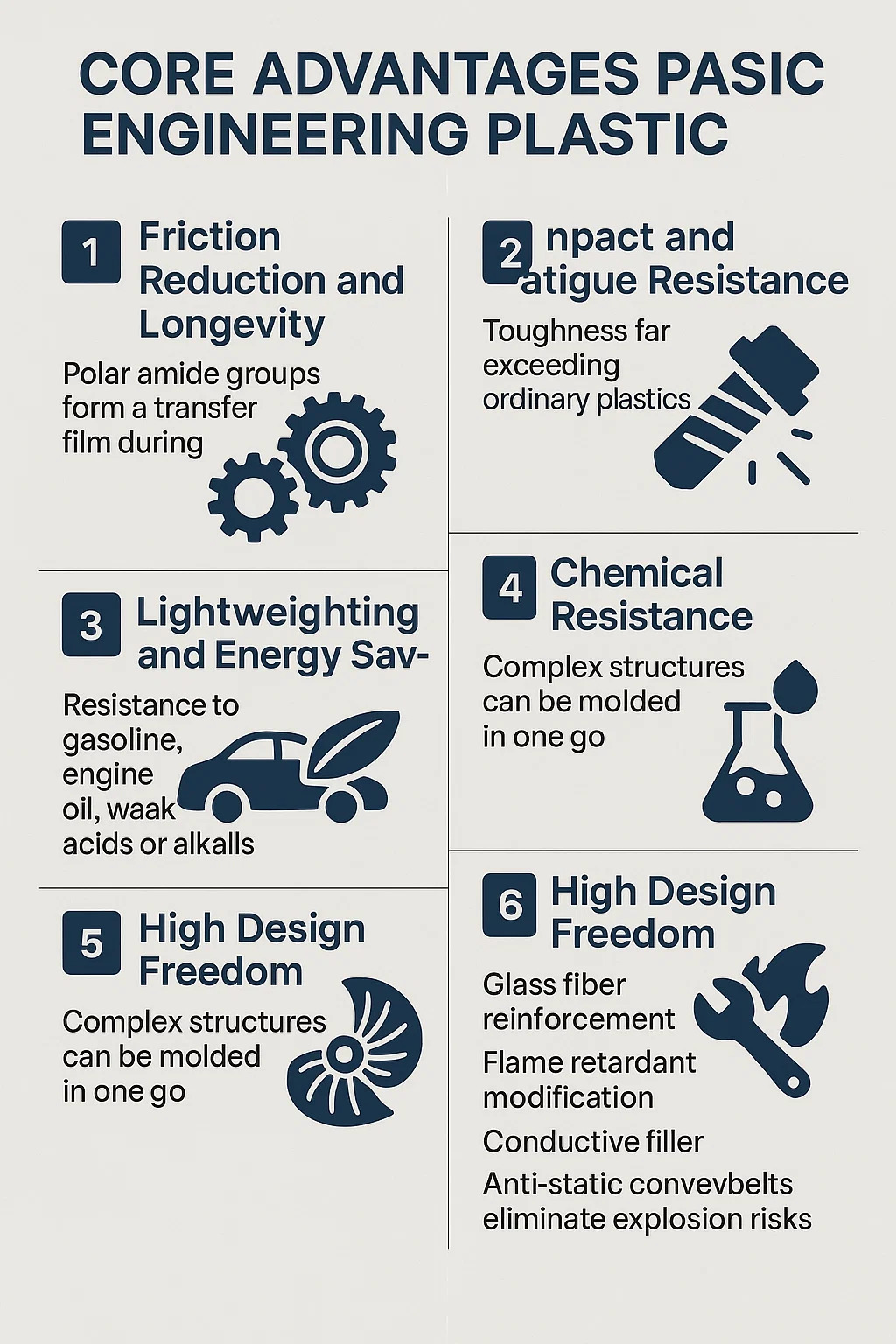
Detailed Explanation of the Core Advantages of Engineering Plastic Polyamide
1. Friction Reduction, Self-Lubrication, Quietness, and Longevity
The molecular chain contains polar amide groups, which form a transfer film during friction, allowing gears and bearings to operate for extended periods without the need for external grease. Compared to metal transmission components, noise is reduced by over 30% and lifespan is extended by five times.
2. Impact and Fatigue Resistance, a Metal Replacement
Toughness Far Exceeding Ordinary Plastics: When reinforced with glass fiber, it can withstand the repeated impact of automotive chassis bolts. Typical applications include hydraulic valve blocks in excavators, which have withstood 100,000 pressure cycles without cracking.
3. Lightweighting and Energy Saving
With a density only one-seventh that of steel, injection-molded automotive intake manifolds are 50% lighter than aluminum parts and offer a 6% reduction in fuel consumption.
4. Chemical Resistance
Resistant to corrosion from gasoline, engine oil, and weak acids and alkalis. Nylon valve seals in chemical plants have a lifespan three times longer than rubber parts, eliminating frequent downtime and replacement.
5. High Design Freedom
Complex structures can be molded in one go: The aerodynamic curves of turbofan blades can be molded with an accuracy of ±0.05mm, eliminating metal cutting costs.
6. Broad Modification Options
Glass Fiber Reinforcement: Temperature resistance extends from 80°C to 200°C, making it a top choice for engine peripheral parts.
Flame Retardant Modification: 3mm thin-walled materials achieve UL94 V-0 certification, making charging station casings flame-retardant.
Conductive Filler: Anti-static conveyor belts eliminate explosion risks in electronics factories.
| Advantage | Engineering Value & Real-World Impact |
| Self-Lubrication | Forms transfer films during friction, enabling oil-free operation (ideal for food/medical machinery). |
| Impact & Fatigue Resistance | Withstands repeated shock loads (e.g., hydraulic valves) – outlasts metals in dynamic applications. |
| Weight Reduction | 1/7 the density of steel → slashes energy consumption (e.g., lighter automotive parts cut fuel usage). |
| Chemical Resistance | Defies oils, fuels, and weak acids/alkalis → extends service life in corrosive industrial settings. |
| Design Freedom | Enables complex geometries (e.g., aerodynamic impellers) via precision molding, eliminating machining. |
| Modification Versatility | • Glass fiber: Boosts heat resistance (80°C→200°C)• Flame-retardant: Meets safety standards (e.g., EV charging housings)• Conductive fillers: Prevents static in electronics. |
| Fail-Safe Mechanism | Sacrificial failure (e.g., gear teeth shear) protects critical systems like motors/driveshafts. |
| Vibration Damping | Absorbs harmonics → reduces noise in appliances/industrial equipment by damping resonance. |
 Mob: +86-15867822829
 Tel: +86-0574-62538663
 Fax: +86-0574-62530664
 E-mail:
 Follow Us
 Home
Home
